Connected
Healthcare 2030
Keeping healthcare
human
A look ahead at the healthcare customer experience of the next decade — where people-centered care graduates from platitude to mandate, and technology revolves around the human instead of the other way around.
Get the Strategy Guide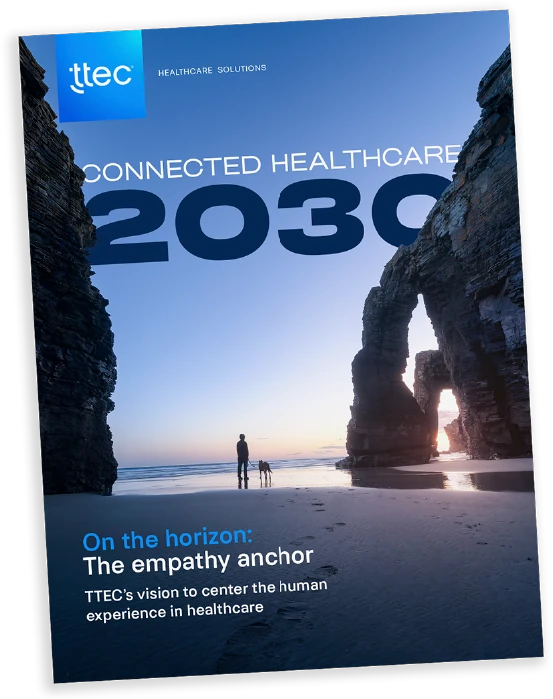
5.8%
Annual growth in health expenditures, outpacing GDP through 2033
$1.3T
Projected global telehealth market by 2034
$1T
Annual healthcare spending shifting to digital-first, proactive care

The Vision
An introduction to
healthcare in 2030
People-centered healthcare has graduated from platitude to mandate. It’s a strategy that can be operationalized at countless touchpoints and measured to deliver a solid return on investment.
Organizations that re-think the healthcare operating environment today — retiring legacy tactics and replacing them with new people-centric processes and technology — will emerge as the most-admired megastars of tomorrow. Years from now, healthcare will look very different.
“We see a new healthcare ecosystem taking shape that puts people at the epicenter of everything. Processes and technology will revolve around the human, no longer burdened to navigate a tangled, disconnected system.”
Front- and back-office teams will carry out their daily tasks with a different world view: trained to be empathetic, supported by automation, empowered by knowledge, and rewarded for performance that improves experiences. Data analytics used in creative new ways will reveal insights that inform decision-making, enabling leaders to deploy proactive strategies with confidence.
What's inside this guide

A vision for a people-centered healthcare ecosystem by 2030
How to keep healthcare human across every touchpoint
Four key takeaways for reimagining the operating environment
What healthcare can’t look like in the future — and where we need to go instead
The market forces driving momentum for connected care
Key takeaways
Four shifts defining healthcare in 2030
The new operating environment of 2030 features a digital front door that opens to an integrated suite of solutions — built on four foundational shifts.

Mitigate
fragmentation
A digital front door opens to integrated solutions. Health advocates shift to proactive, concierge-level support — scheduling preventive care before it’s asked for, powered by conversational AI and personalized analytics.

Enable an
empathetic workforce
Enhanced training, flexible staffing, and nearshore delivery create specialized healthcare advocates. AI flags compassion fatigue and proactively offers resources — balancing talent, technology, and training.

Respond to
demographics & equity
An enlightened educational curriculum helps advocates empathize with people from all walks of life. AI-based training bots and role-playing build skills for equitable, respectful, personalized care.

Expand
value-based care
When providers move from fee-for-service to value-based delivery, they’re incentivized to invest in prevention. The result: better patient health, greater engagement, and lower cost across the entire system.
What Healthcare Can’t Look Like
Eliminate what simply can’t work
One of the best ways to predict macro-level trends is to eliminate scenarios that simply can’t work in the
future. A firm understanding of what to avoid makes it clear where we need to go.
Instead, put humans at the center of a connected experience.

…just trust the system
Patients shouldn’t be left to navigate a tangled, disconnected system on their own.
…sabotage our ability to leverage modern tools
AI and automation must be embraced, not resisted, to strip out friction points.
…accept inefficiency
Legacy processes and rigid workforce models are too brittle for tomorrow’s demands.
…forget about the people
Technology revolves around the human — empathy is the anchor, not an afterthought.

Get the strategy guide
Explore TTEC’s vision for a healthcare operating environment that keeps healthcare human — from a digital front door to concierge-level, empathetic care.